 Examples
Abstract
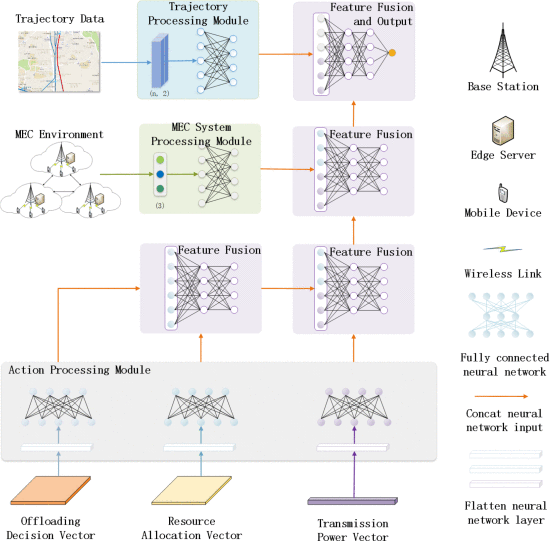
Mobile Edge Computing (MEC) places computational resources at the network edge, thereby enabling compute-intensive applications through task offloading. However, in dynamic multi-user, multi-server environments, user mobility induces time-varying channel conditions, and the spatiotemporal heterogeneity of server loads further complicates system behavior. Consequently, the system must jointly optimize discrete offloading decisions and continuous resource-allocation parameters, forming a hybrid action space whose integrated decision-making mechanism is central to breaking the long-standing trade-off between latency and energy consumption. Traditional deep reinforcement learning (DRL) approaches that rely on a single policy network often suffer from strong strategy coupling and Q-value estimation bias, leading to policy oscillations and the curse of dimensionality in highly dynamic scenarios and thus impeding stable convergence. To address this problem, this paper proposes an innovative End-to-End Hybrid Computation Offloading (E2EHCO) framework based on an enhanced Twin Delayed Deep Deterministic Policy Gradient (TD3) algorithm. By employing dual critic networks together with a delayed-update mechanism, the method effectively suppresses Q-value overestimation, while the integration of Softmax and Tanh activations in the actor network allows simultaneous handling of discrete and continuous actions, thereby achieving efficient and robust joint decision optimization under dynamically changing conditions. Experiments on real-world mobility traces show that, relative to benchmark methods, E2EHCO reduces total latency by at least 20% and energy consumption by approximately 16% in high-density user scenarios, providing an adaptive offloading solution with real-time responsiveness for large-scale, dynamic MEC systems.

Jian Yin 尹建
Engineer
My research interests include Computer Vision, Computer Graphics, Deep Learning, Reinforcement Learning.